Mon-Fri | 08:00 - 20:00


Find

Contact us

Kyiv
46 Kyrylivska St. (Podil)
 Мережа СТО в місті

Kyiv
46 Kyrylivska St. (Podil)
 Мережа СТО в місті

 Години роботи
 Mon-Fri
08:00 - 20:00
Headlights fogging from the inside: normal condensation or a sign of housing damage
Moisture inside a light unit does not always mean there is a fault. A modern headlight is not a completely sealed chamber because temperature and air pressure inside it change during operation.
After a car wash, rain, or a sudden temperature change, light condensation may appear on the inside of the lens. This is related to the dew point, when moisture in the air turns into droplets as the surface cools.
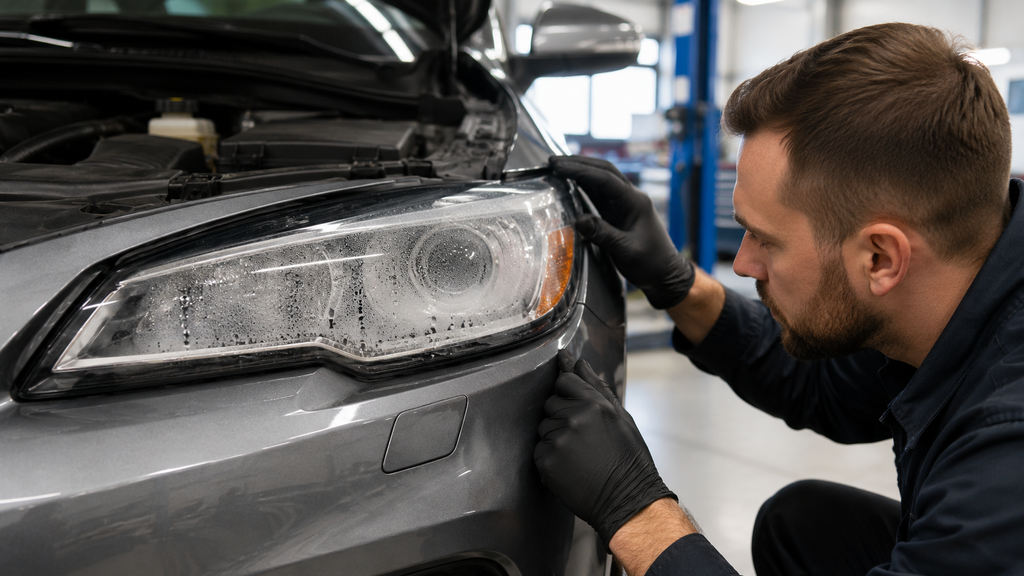
Headlight fogging from the inside can have different causes, ranging from normal condensation after washing or rain to a loss of housing sealing. In some cases, it is simply a normal response of the light unit to changing environmental conditions.
However, persistent moisture inside the housing, large water droplets, or pooled liquid already indicate a ventilation or sealing problem.
Why light condensation after rain or washing is considered normal
The headlight housing is designed to protect electronics, the bulb, or an LED module from external influences. However, completely isolating the air inside is neither possible nor desirable.
When the lights operate, the temperature inside the housing rises. After the headlight is switched off, the air cools and excess moisture can settle on the inner surface of the lens.
Normal fogging usually has the following characteristics:
- a thin, even film of mist;
- no large droplets;
- it disappears after the headlight warms up;
- it appears after rain or washing.
The question of whether it is normal for a headlight to fog up after rain has a simple answer: light condensation is a natural phenomenon in most cases because temperature changes inside the housing create moisture; it usually does not affect light operation and disappears on its own.
How headlight ventilation works and why a breather is needed
A special pressure-equalisation system is built into the housing. It uses a ventilation passage, often referred to as a breather.
Air can pass through it between the inside of the headlight and the outside environment. A special filter element helps keep dust and dirt particles out.
The location depends on the design of the specific light unit, but where the headlight ventilation breather is located can usually be determined by checking the rear or lower part of the housing.
Problems occur when the ventilation passage becomes clogged or damaged. In this situation, moisture accumulates faster and natural drying becomes more difficult.
The condition of the housing and lens also matters. Cracks, deformation, or damage to the headlight sealant compromise the unit’s resistance to moisture.
How long condensation takes to dry
The time required for moisture to disappear depends on air temperature, humidity, the design of the light unit, and the condition of its ventilation passages.
A light mist on the lens usually disappears after driving, when the headlight warms up during operation. In warm, dry weather, this may take several hours.
When determining how long water in a headlight should take to dry, it is important to consider not only the presence of condensation but also how it behaves.
A normal situation is when:
- the amount of moisture gradually decreases;
- the lens becomes clear after drying;
- condensation does not collect in one area;
- the issue occurs only after washing or precipitation.
It is a warning sign when moisture remains for a long time or appears without any obvious external cause.
When fogging indicates a fault
Persistent condensation inside a light unit often indicates a sealing problem or an issue with ventilation.
Possible signs of a fault include:
- large droplets on the inner surface of the lens;
- water collecting at the bottom of the housing;
- moisture that does not disappear for a long time;
- regular fogging after every drive in wet weather;
- signs of oxidation on electrical contacts.
If moisture inside the light unit does not disappear for a long time, the cause should be sought in the ventilation system, housing, or headlight seal. A blocked breather, damaged housing, cracked lens, or compromised sealant may be responsible.
Particular attention should be paid to modern lights with LED or xenon modules. The electronic components inside these headlights are sensitive to high humidity, and prolonged contact with water can affect their reliability.
What to do when moisture appears inside a headlight
Before repair begins, the cause of the condensation must be identified. Not every fogged headlight needs to be dismantled or replaced.
The correct action depends on the condition of the light unit:
- Light fogging after rain or washing can be monitored for a while. Natural drying is often sufficient.
- A dirty ventilation passage should be cleaned to restore normal airflow.
- A loss of housing sealing requires repair and restoration of the protective seal.
After the light unit has been dismantled, it is important to carry out headlight resealing after repair correctly. Using unsuitable material or assembling the unit incorrectly can allow moisture to enter again.
If the housing is badly damaged, cracked, or an internal module has failed, repair may not be worthwhile. In that case, headlight replacement may be considered.
Fogging does not always mean there is a problem. Light condensation after a temperature change is normal for many headlight designs. However, water inside the housing, persistent moisture, or signs of damage should be checked because the condition of the headlight affects not only the appearance of the vehicle but also the reliability of the lighting system.
Top popular news
- Preparing a car for a long trip: checklist before departure
- Oil leaking from the valve cover: causes of seepage and finding the source of the problem
- Automatic climate control does not maintain the set temperature: where to look for the cause
- Brake pipes and hoses: different designs with different risks
- Suspension spring sagging: gradual loss of performance without an obvious failure
- PCV crankcase ventilation valve: why a fault leads to oil leaks
- Steering rack: hydraulic leak or electric power-steering fault – how the problem is diagnosed
- Engine air and cabin filter replacement: why urban conditions change service intervals

Subscribe to our newsletter!
To stay updated with the latest news


Book a service