Mon-Sut | 09:00 - 19:00


Find

Contact us

Kyiv
18 Teplovozna Street (Poznyaki)
 Мережа СТО в місті

Kyiv
18 Teplovozna Street (Poznyaki)
 Мережа СТО в місті

 Години роботи
 Mon-Sut
09:00 - 19:00


Factory Paint Thickness of a Car: How to Read Paint Thickness Gauge Measurements
A seller’s claim that a vehicle has «never been in an accident and has never been repainted» should not be taken as proof. A paint inspection can confirm or disprove these claims. Before inspecting a used car, it is advisable to rent or purchase a paint thickness gauge. Just a few minutes of measurements can reveal repainted panels, hidden body repairs, or signs of a serious accident before the purchase is completed.
What Is Factory Paint Thickness?
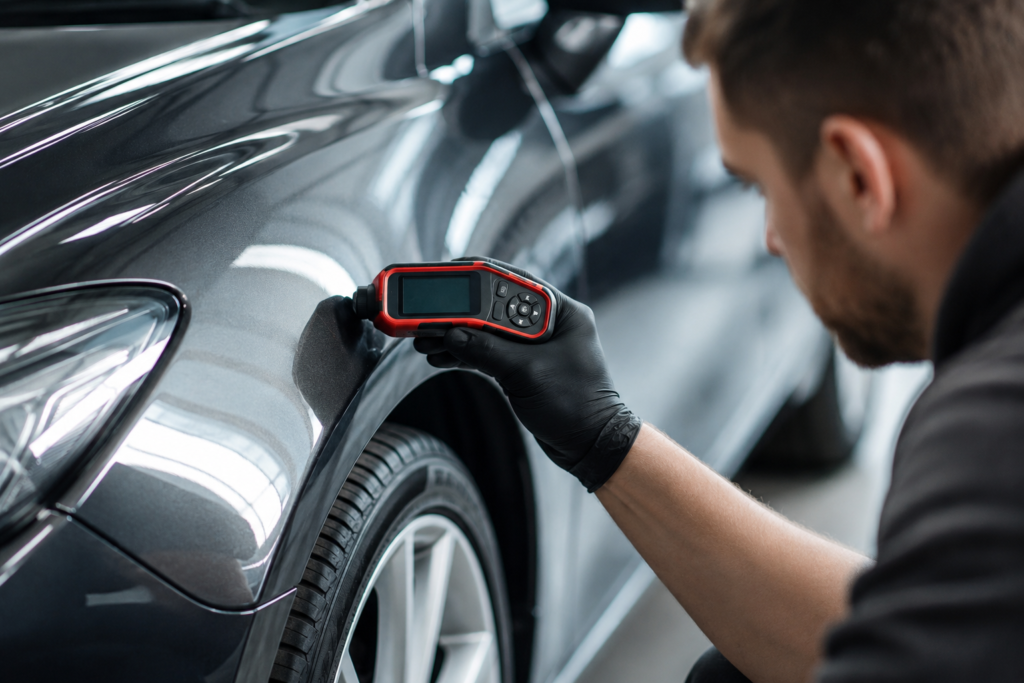
A paint thickness gauge measures the thickness of the coating in microns. One micron equals 0.001 mm, so even small differences are clearly visible during inspection.
To correctly evaluate the readings, it is useful to have a reference table of factory paint thickness values for different vehicle manufacturers. For most Japanese and Korean models, 80-110 microns is considered normal, while VAG, BMW, and Mercedes vehicles typically have factory paint thickness between 110-150 microns.
Interior surfaces should not be compared with exterior body panels. Pillars, inner sills, frame rails, and wheel arches often measure only 40-80 microns because corrosion protection is mainly provided by the cathodic electrocoating primer rather than a thick layer of paint.
How to Properly Use a Paint Thickness Gauge When Buying a Car
Anyone who wants to understand how to use a paint thickness gauge when buying a car should measure the entire body instead of checking just one panel. Only by comparing adjacent body panels can hidden differences be detected.
During the inspection, it is recommended to check:
- hood, roof, and trunk lid;
- front and rear fenders;
- all doors;
- door jambs;
- inner wheel arches;
- center pillars.
If one body panel differs significantly from the adjacent ones, it is a reason to inspect that area more carefully.
How to Properly Evaluate the Results
The readings should always be analyzed together with the vehicle’s overall condition.
160-250 microns usually indicate a repaint. In most cases, this is done to repair scratches or stone chips without serious damage to the metal.
300-600 microns may indicate the use of a thin layer of body filler after repairing a minor dent. By itself, this result does not necessarily confirm that the vehicle suffered a severe impact.
More than 1000 microns or unstable readings often indicate a significant amount of body filler. In such cases, the body geometry should be carefully inspected because the repair may have been extensive.
If you want to identify repainted body panels, measurements should be taken on all adjacent panels. Sharp differences between neighboring readings almost always indicate localized repair work.
How Repair Work Is Hidden
Some technicians carefully match the thickness of the new coating to the factory specification. Another masking method involves using body filler with aluminum powder, which can affect the readings of certain paint thickness gauges.
For this reason, the inspection should not be limited to large exterior panels. Door jambs, inner wheel arches, areas around welds, and body mounting points should also be checked. These are the places where signs of accident repairs most often remain.
Common Mistakes Buyers Make
- measuring only the doors or fenders;
- ignoring the roof and pillars;
- skipping the inspection of the inner wheel arches;
- comparing only one or two readings instead of inspecting the entire body.
Why a Paint Thickness Gauge Alone Is Not Enough
Even a high quality paint thickness gauge cannot determine how professionally the repair was performed. When evaluating a vehicle after body repairs, it is also important to inspect panel gaps, seam sealer, signs of bolt removal, dust trapped under the clear coat, and whether the paint shade matches the surrounding panels.
Before purchasing a vehicle, many buyers order a professional paint inspection in Kyiv to evaluate not only the coating thickness but also the quality of previous repairs. Combining paint thickness measurements with a professional inspection provides a much more accurate assessment of the vehicle’s actual condition and helps determine whether the repair was only cosmetic or whether the body was restored after significant damage.
Top popular news
- Vehicle Maintenance Schedule by Mileage: What Really Needs to Be Replaced at 30,000, 60,000, and 90,000 km
- Importing a Car from the USA to Ukraine: Required Documents and Customs Clearance Costs
- Switching from LPG to Gasoline While Driving: Why the Switching Valve Sometimes Fails
- Wheel Balancing: Why Vibration at High Speed Does Not Always Mean a Bent Rim
- Car Air Conditioner Disinfection: Why It Is Necessary and How Often It Should Be Done
- CV Boot: Why Replacing It Costs Much Less Than Repairing the Drive Shaft
- Wheel Bearing Noise: How to Identify Which Wheel Is Faulty
- Car Soundproofing: Where to Start for the Best Results

Subscribe to our newsletter!
To stay updated with the latest news


Book a service