Mon-Sut | 09:00 - 19:00


Find

Contact us

Kyiv
18 Teplovozna Street (Poznyaki)
 Мережа СТО в місті

Kyiv
18 Teplovozna Street (Poznyaki)
 Мережа СТО в місті

 Години роботи
 Mon-Sut
09:00 - 19:00


Vehicle Maintenance Schedule by Mileage: What Really Needs to Be Replaced at 30,000, 60,000, and 90,000 km
Many drivers treat the figures in the service manual as fixed rules. In reality, a vehicle maintenance schedule is a guideline that should be adjusted to actual driving conditions. A car that spends most of its time in traffic jams, regularly makes short trips, or idles for long periods accumulates engine hours much faster than mileage. That is why city driving is considered severe operating conditions, and the maintenance intervals recommended by the manufacturer often need to be shortened.
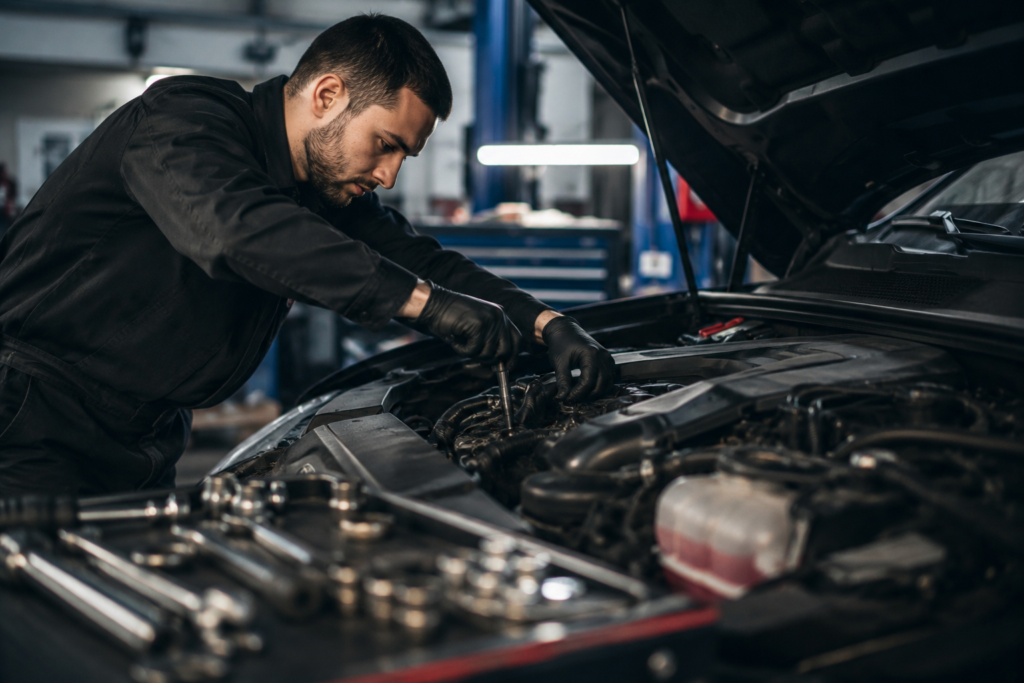
At the same time, not every maintenance procedure should be performed strictly based on mileage. Some components should be serviced only after proper inspection, while engine oil, fluids, and filters should never be neglected. This approach helps avoid paying for unnecessary work while preventing expensive repairs.
30,000 km: Early Preventive Maintenance
The first 30,000 kilometers are often considered the second major scheduled service. At this point, changing only the engine oil is no longer sufficient.
A typical maintenance service at this mileage includes:
- engine oil replacement;
- replacement of the oil filter, air filter, and cabin air filter;
- inspection of brake pads and brake discs;
- suspension inspection;
- spark plug condition check.
Special attention should be paid to the brake fluid. Over time, it absorbs moisture, reducing its boiling point. During long downhill driving or repeated hard braking, this can reduce braking performance. For this reason, most manufacturers recommend replacing brake fluid approximately every two years or every 30,000–40,000 km.
Turbocharged engines also require careful inspection of the spark plugs. If excessive oil consumption or uneven cylinder operation is suspected, technicians may additionally perform a borescope inspection, allowing the combustion chambers to be examined without disassembling the engine.
60,000 km: The Most Important Milestone for the Transmission
After approximately 60,000 kilometers, many expensive drivetrain components become much more sensitive to maintenance quality.
When owners ask what should be replaced at 60,000 km, the transmission is usually the first priority.
Automatic Transmission Fluid (ATF) gradually loses its lubricating, cooling, and protective properties. Despite the common claim that transmission fluid is “lifetime fill,” replacing it on schedule significantly extends the service life of the valve body, solenoids, and clutch packs. DSG dual clutch transmissions and continuously variable transmissions (CVTs) also have their own fluid replacement intervals that should be followed.
The fuel system should also be inspected. For diesel vehicles and models equipped with an external fuel filter, timely replacement protects the high pressure fuel pump and fuel injectors from contamination.
Iridium and platinum spark plugs often reach the end of their service life by this mileage. As the electrode gap increases, ignition coils must work harder, accelerating their wear.
The coolant should also be evaluated. If the manufacturer’s maintenance schedule requires replacement or testing indicates that its protective properties have deteriorated, the coolant should be renewed to prevent internal corrosion within the cooling system.
90,000 km: Comprehensive Inspection of Major Components
By 90,000 kilometers, the vehicle requires a complete technical inspection rather than isolated maintenance procedures.
If the engine uses a timing belt, it should be replaced together with the tensioners, idler pulleys, and, if necessary, the water pump. The cost of this service is significantly lower than repairing an engine after a timing belt failure.
If the engine uses a timing chain, technicians should inspect chain stretch, the condition of the tensioners, and listen for abnormal noises during engine start up and operation. Without such an inspection, determining the remaining service life of the timing chain is nearly impossible.
For all wheel drive vehicles, replacing the lubricant in the transfer case and differentials is recommended. Although these components operate in sealed housings, the lubricant gradually deteriorates due to high temperatures and normal wear.
At the same time, a detailed inspection of the suspension and steering system should be performed. Technicians evaluate the condition of suspension bushings, ball joints, shock absorbers, steering tie rod ends, and brake discs, which often require replacement after several sets of brake pads.
How to Avoid Overpaying for Maintenance
Not every maintenance procedure should be performed automatically simply because a certain mileage has been reached. For example, some suspension or auxiliary components may remain in excellent condition well beyond the recommended interval. However, saving money by delaying engine oil changes, fluid replacements, timing belts, filters, or spark plugs is never advisable because these components directly affect the lifespan of the vehicle’s most expensive systems.
The vehicle service manual provides the manufacturer’s maintenance schedule, but it should always be considered together with actual operating conditions and the results of a professional inspection. This approach allows owners to create the most effective maintenance plan without unnecessary expenses while ensuring that no critical service items are overlooked.
For Mercedes owners, the cost of scheduled maintenance depends on the vehicle model, engine type, and the required service operations. If you are looking for Mercedes maintenance in Kyiv, the final price is determined after a comprehensive inspection and is almost always significantly lower than the cost of repairing a major mechanical failure.
Top popular news
- Importing a Car from the USA to Ukraine: Required Documents and Customs Clearance Costs
- Switching from LPG to Gasoline While Driving: Why the Switching Valve Sometimes Fails
- Wheel Balancing: Why Vibration at High Speed Does Not Always Mean a Bent Rim
- Car Air Conditioner Disinfection: Why It Is Necessary and How Often It Should Be Done
- CV Boot: Why Replacing It Costs Much Less Than Repairing the Drive Shaft
- Wheel Bearing Noise: How to Identify Which Wheel Is Faulty
- Car Soundproofing: Where to Start for the Best Results
- Factory Paint Thickness of a Car: How to Read Paint Thickness Gauge Measurements

Subscribe to our newsletter!
To stay updated with the latest news


Book a service