Mon-Sut | 09:00 - 19:00


Find

Contact us

Kyiv
18 Teplovozna Street (Poznyaki)
 Мережа СТО в місті

Kyiv
18 Teplovozna Street (Poznyaki)
 Мережа СТО в місті

 Години роботи
 Mon-Sut
09:00 - 19:00


Why does a car suddenly start to “live its own life”: electronic system failures and ECU malfunctions
When the Problem Is Not the Sensors but the Control Unit Itself
Sometimes a vehicle behaves as if several systems have failed at the same time. Various warning messages appear on the dashboard, the engine runs inconsistently, and certain functions work intermittently or suddenly stop responding altogether. After restarting the vehicle, some error messages may disappear, only to reappear later.
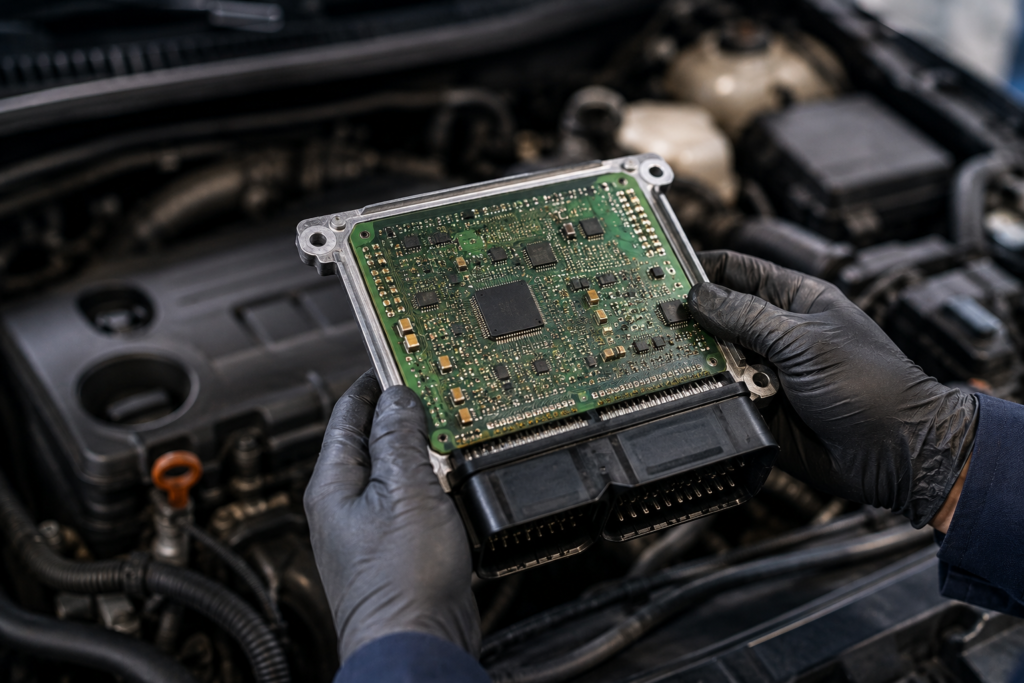
In such situations, many owners begin to suspect faulty sensors or wiring. However, the source of the problem can sometimes be much deeper. If the vehicle’s electronics are malfunctioning without any obvious reason, it is worth paying attention to the electronic control unit (ECU).
The difficulty with such faults is that they often mimic the failure of completely functional components. As a result, randomly replacing sensors or repeatedly clearing error codes rarely solves the problem for long.
What Is an ECU and Why Modern Vehicles Depend on It
The electronic control unit (ECU) is essentially the information processing center of a vehicle. It continuously receives signals from sensors, analyzes them, and controls the operation of various systems.
For example, the crankshaft position sensor provides information about engine speed, while other sensors monitor temperature, pressure, air-fuel mixture composition, and many other parameters. Data transmission between modules takes place through the CAN bus a digital network that integrates the vehicle’s electronics into a single system.
Inside the ECU is a complex electronic circuit board containing a processor, memory chips, and numerous electronic components. Damage to even a small section can affect the operation of several systems simultaneously.
That is why modern vehicles are so sensitive to electronic faults.
What Most Often Causes ECU Failure
Unlike mechanical assemblies, the control unit does not contain parts that constantly wear out during operation. However, there are several factors that gradually reduce its service life.
The most common causes of ECU failures include:
- moisture entering the housing;
- corrosion of contacts and conductive traces;
- voltage fluctuations;
- consequences of improper jump-starting procedures;
- short circuits in the electrical system;
- constant vibrations;
- aging solder joints and electronic components.
Moisture is considered particularly dangerous. Condensation or water that gets inside the housing can slowly damage contacts and electronic components over the course of months. In the early stages, the fault may appear only occasionally, but over time the number of malfunctions increases.
Problems often occur after vehicle flooding or when the sealing of the ECU installation area is compromised.
How to Tell If the Control Unit Is Actually Faulty
An ECU failure rarely has a single clear symptom. More often, the driver observes an entire set of strange issues that seem unrelated at first glance.
The most common symptoms of an engine control unit malfunction include:
- random appearance of various error codes;
- intermittent loss of communication with sensors;
- unstable engine operation;
- starting difficulties;
- malfunctions in electronic systems;
- recurring fault codes after they have been cleared.
It is important to understand that a fault code does not always indicate a defective sensor. For example, a diagnostic scanner may display an error related to a specific sensor even though the actual source of the problem is inside the control unit itself.
That is why clearing vehicle fault codes often provides only a temporary result. If the root cause is not eliminated, the warning message will eventually return.
How a Control Unit Is Repaired and When Repair Is No Longer Possible
The possibility of repair depends on the nature of the damage. For example, corrosion damage, broken circuit board traces, or individual faulty components can often be repaired without replacing the entire unit. In contrast, severe processor or memory damage frequently makes repair economically impractical.
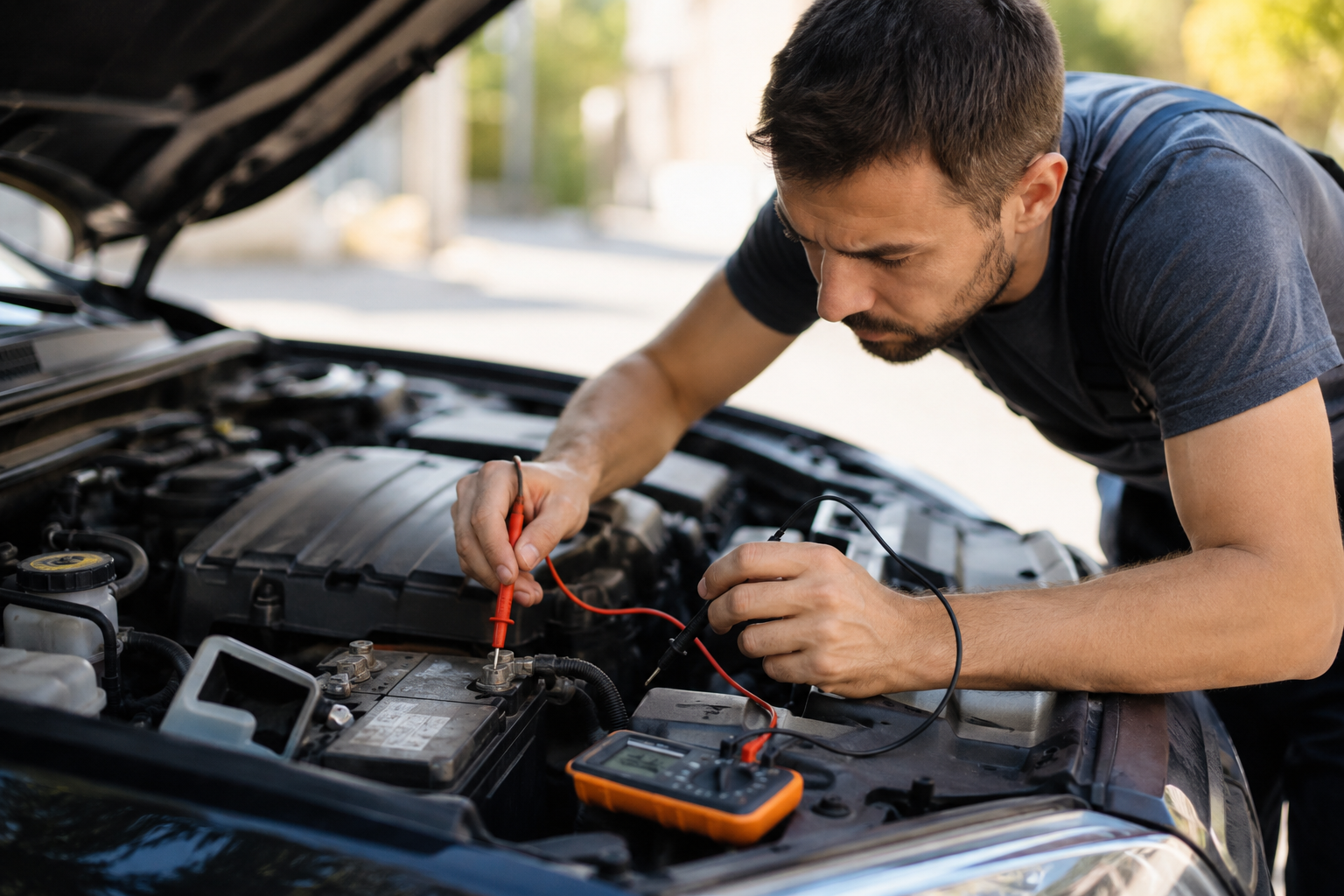
Troubleshooting involves more than just using a diagnostic scanner. In complex cases, an oscilloscope is used to analyze electrical signal waveforms and identify defects that are not visible during standard computer diagnostics.
Depending on the diagnostic results, the following procedures may be performed:
- restoration of damaged circuit board traces;
- removal of corrosion damage from contacts;
- replacement of individual electronic components;
- resoldering of connections;
- ECU programming or reflashing;
- software restoration.
Many vehicle owners are interested not only in the cause of the fault but also in the cost of ECU diagnostics, since a proper inspection helps determine whether the control unit requires repair or whether the problem lies elsewhere in the vehicle.
When the damage is too severe, the control unit must be replaced. In such cases, the new module must be adapted to the specific vehicle and synchronized with its other electronic systems.
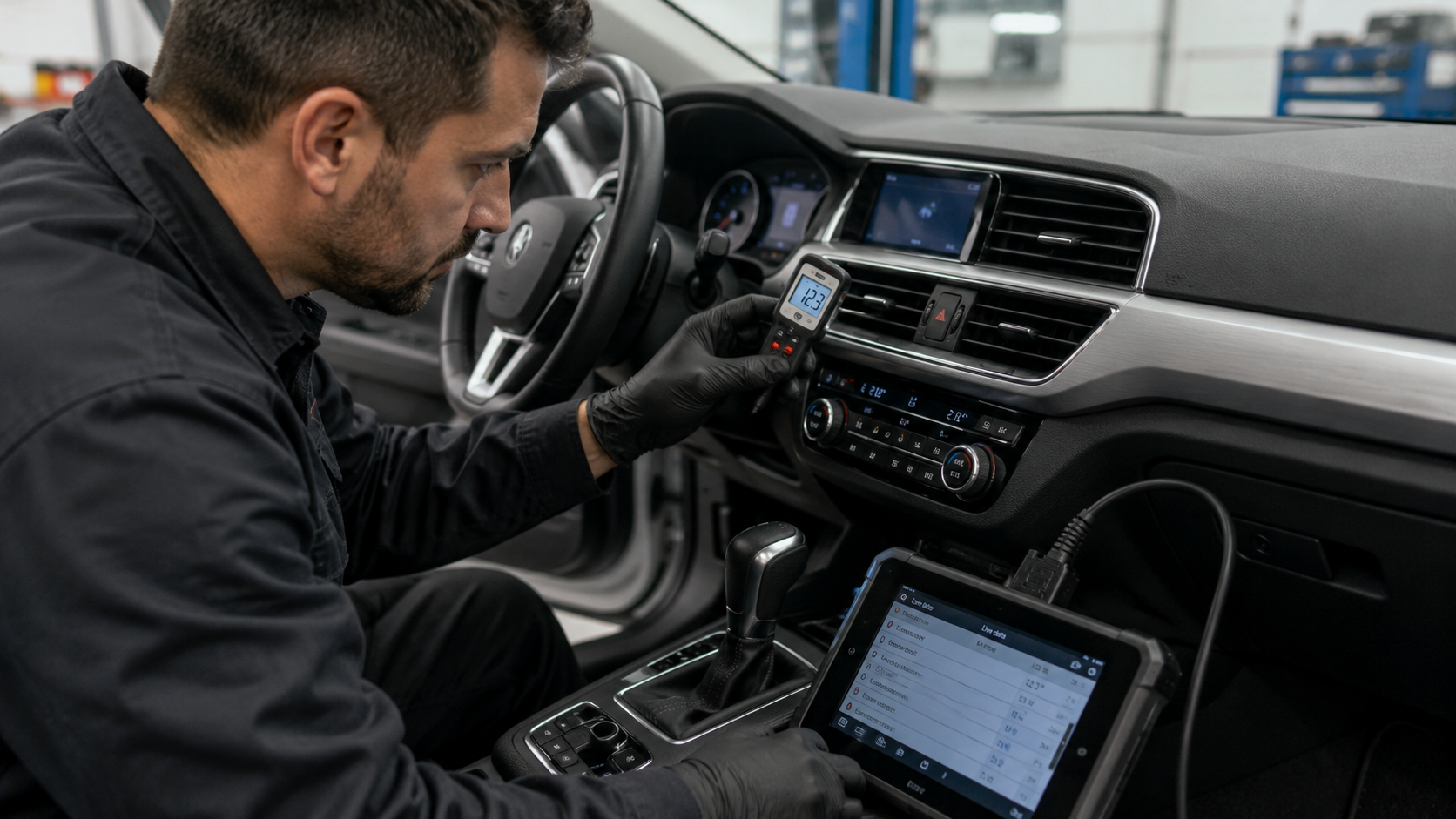
That is why computer vehicle diagnostics remains an important step in identifying complex electronic faults. It helps distinguish control unit failures from problems involving sensors, wiring, or actuators.
The earlier a defect in the electronic control unit is identified, the greater the chance of restoring its functionality without complete replacement. This is especially true when the failure is caused by moisture, localized corrosion, or damage to individual elements of the electronic circuit board.
Repairing electronic vehicle control units often allows the problem to be resolved at a significantly lower cost than replacing the entire module. The key is to correctly identify the source of the fault and not limit the repair process to simply clearing error codes from the system memory.
Top popular news
- Air Conditioner Losing Refrigerant Without Visible Damage: Causes and Solutions
- Why Wheel Alignment Goes Out After Adjustment: It Is Not Always the Alignment Rack
- Seized Brake Caliper: Symptoms, Causes, and Repair
- Changing the Oil in an AWD Differential: Why This Component Is Often Forgotten
- Check Engine Light Flashing: What the Signal Means and Why You Should Not Ignore It
- Preparing a car for a long trip: checklist before departure
- Oil leaking from the valve cover: causes of seepage and finding the source of the problem
- Automatic climate control does not maintain the set temperature: where to look for the cause

Subscribe to our newsletter!
To stay updated with the latest news


Book a service