Mon-Sut | 09:00 - 19:00


Find

Contact us

Kyiv
18 Teplovozna Street (Poznyaki)
 Мережа СТО в місті

Kyiv
18 Teplovozna Street (Poznyaki)
 Мережа СТО в місті

 Години роботи
 Mon-Sut
09:00 - 19:00


CV Boot: Why Replacing It Costs Much Less Than Repairing the Drive Shaft
A CV joint, or Constant Velocity Joint, transfers torque from the transmission to the wheels regardless of the steering angle or suspension movement. It is one of the most heavily loaded components of the suspension system and operates under constant mechanical stress. To protect it from dust, water, and road debris, it is covered by a CV boot, a flexible rubber bellows that keeps grease inside the joint and maintains a sealed environment.
A small crack in the CV boot may seem like a minor issue, but it is exactly what determines the consequences of a torn CV boot. If the damage is not repaired in time, replacing an inexpensive rubber boot can turn into repairing or even replacing the entire drive shaft.
Why a Damaged CV Boot Quickly Destroys the CV Joint
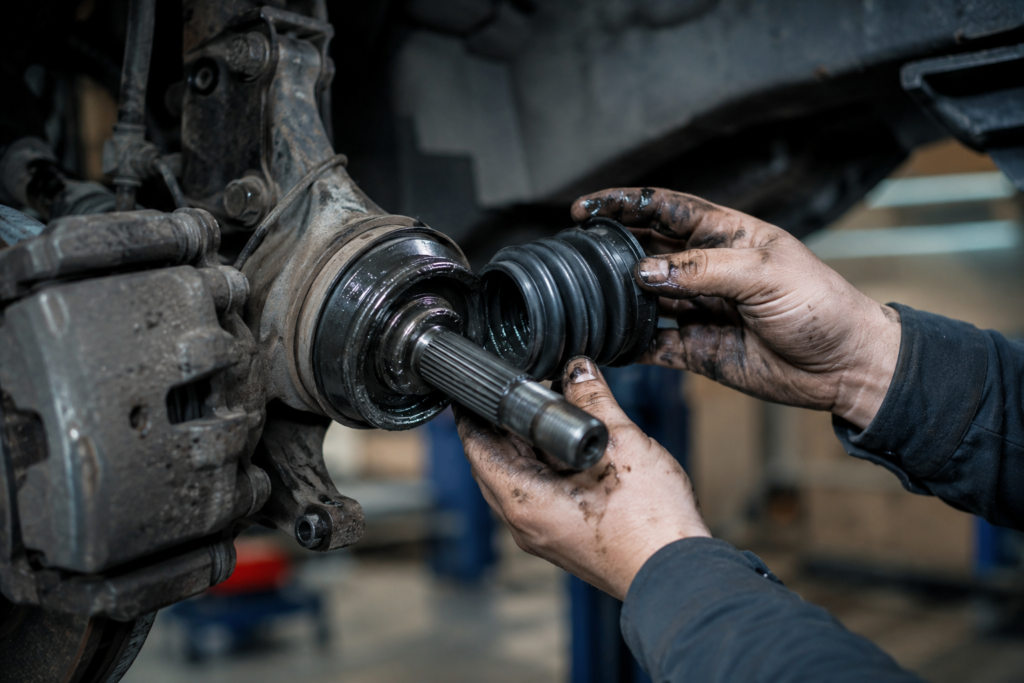
Inside the CV joint are balls, a cage, and bearing races whose surfaces must remain constantly coated with special CV joint grease. In most cases, lithium grease with molybdenum disulfide is used because it withstands high loads and large steering angles.
Once a crack appears, centrifugal force begins to take effect. As the drive shaft rotates, the grease is gradually thrown out, while water, sand, and road dust enter through the damaged boot. Soon the remaining grease mixes with contaminants and turns into an abrasive paste that rapidly wears the joint balls, cage, and bearing races.
Even a few days of driving with a damaged CV boot can significantly reduce the service life of the CV joint.
The Difference Between Outer and Inner CV Boots
The outer CV joint operates at the greatest steering angles, making its boot the one that fails most often. The first sign is usually grease splattered on the inside of the wheel rim, the wheel arch liner, or nearby suspension components.
The inner CV boot fails somewhat differently. Because it is located closer to the engine and exhaust system, the rubber ages faster and loses its elasticity. If the seal is compromised, the tripod joint or inner CV joint gradually wears out, and noticeable body vibrations may appear during hard acceleration.
The problem can often be detected before any unusual noises develop. Typical signs include:
- grease stains on the wheel rim or wheel arch liner;
- cracks or tears in the rubber boot;
- loose or damaged clamps;
- dirt and contamination around the drive shaft.
The earlier the damage is detected, the greater the chance of saving the CV joint without an expensive replacement.
When the CV Joint Can Still Be Saved
If water and sand have not yet entered the joint, it can usually be restored. The joint is disassembled, thoroughly cleaned, inspected for wear, packed with fresh grease, and fitted with a new CV boot.
New clamps should always be installed during reassembly. Reusing old clamps does not provide a reliable seal, and even a slight loss of tightness can make the entire repair ineffective.
If the CV joint produces a clicking noise while turning, the balls and bearing races have already suffered irreversible damage. This clicking is most noticeable when starting from a standstill with the steering wheel turned fully. In this situation, replacing only the boot will no longer solve the problem.
Why You Should Not Delay Repairs
CV joint wear does not stop on its own. Over time, internal wear increases, vibrations become stronger, and damage to the bearing cage accelerates the deterioration of other components inside the joint. In severe cases, the drive shaft can fail completely while the vehicle is moving.
It is especially important to inspect CV boots after off road driving and after the winter season, when the rubber is constantly exposed to moisture, road salt, and repeated temperature changes.
Why Timely Replacement Is More Cost Effective
If the inspection reveals only a damaged CV boot, replacing the protective boot, installing fresh grease, and fitting new clamps are usually all that is required. The cost of replacing a CV boot is significantly lower than purchasing a complete original drive shaft assembly.
During suspension repairs on the right bank of Kyiv, technicians also inspect the condition of the CV joint itself to determine whether replacing the boot is sufficient or whether the entire joint must be replaced. This approach helps avoid unnecessary expenses and significantly extends the service life of the drivetrain.
Top popular news
- Vehicle Maintenance Schedule by Mileage: What Really Needs to Be Replaced at 30,000, 60,000, and 90,000 km
- Importing a Car from the USA to Ukraine: Required Documents and Customs Clearance Costs
- Switching from LPG to Gasoline While Driving: Why the Switching Valve Sometimes Fails
- Wheel Balancing: Why Vibration at High Speed Does Not Always Mean a Bent Rim
- Car Air Conditioner Disinfection: Why It Is Necessary and How Often It Should Be Done
- Wheel Bearing Noise: How to Identify Which Wheel Is Faulty
- Car Soundproofing: Where to Start for the Best Results
- Factory Paint Thickness of a Car: How to Read Paint Thickness Gauge Measurements

Subscribe to our newsletter!
To stay updated with the latest news


Book a service