Mon-Sut | 09:00 - 19:00


Find

Contact us

Kyiv
18 Teplovozna Street (Poznyaki)
 Мережа СТО в місті

Kyiv
18 Teplovozna Street (Poznyaki)
 Мережа СТО в місті

 Години роботи
 Mon-Sut
09:00 - 19:00


Importing a Car from the USA to Ukraine: Required Documents and Customs Clearance Costs
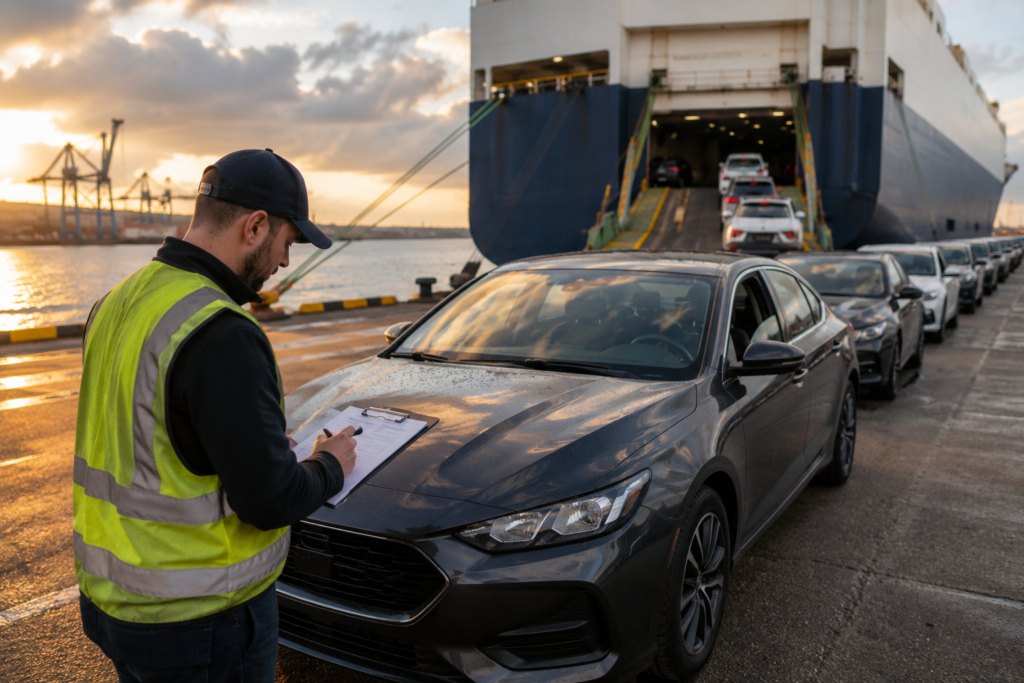
Your vehicle has already been purchased at a US auction and is on its way by sea to a European port. One of the most important stages is still ahead, customs clearance in Ukraine. This step accounts for a significant portion of the total cost, so it is important to calculate your budget before the vehicle arrives. The cost of importing and customs clearing a car from the USA to Ukraine depends not only on the purchase price but also on the vehicle’s technical specifications, the accuracy of the documentation, and the current customs duty rates.
What Documents Are Required
To complete customs clearance, you must prepare the documents received after purchasing the vehicle.
Title
The Title is the American vehicle ownership document that confirms legal ownership. Its status is extremely important. Designations such as Clean, Salvage, or Flood may affect not only the vehicle’s market value but also its eligibility for registration and restoration in Ukraine.
Invoice
The Invoice confirms the actual purchase price paid at the auction. This document serves as the primary proof of the vehicle’s value when determining its customs value.
Bill of Lading
The Bill of Lading confirms that the vehicle has been transported by sea. It contains information about the carrier, shipping route, sender, recipient, and cargo itself. However, this document only confirms transportation and does not determine the vehicle’s value.
These are the documents people refer to when asking what paperwork is required for customs clearance. Without this documentation, the customs process cannot begin.
How the Customs Value Is Calculated
The customs value serves as the basis for calculating most import charges. It is determined using the invoice, shipping documents, and other information related to the vehicle. Import duty, excise tax, and Value Added Tax (VAT) are then calculated based on this value.
In simplified form, the calculation is as follows:
Customs value + import duty + excise tax + VAT = total customs charges.
Depending on current legislation, additional mandatory customs duties and fees may also apply.
Import Duty
For most passenger vehicles, the import duty is 10% of the vehicle’s customs value.
Excise Tax
The amount of excise tax depends on:
- engine type;
- engine displacement;
- vehicle age.
The older the vehicle and the larger its engine, the higher the excise tax.
Electric vehicles may qualify for separate tax incentives under current legislation. Before purchasing, it is advisable to verify the applicable tax rates in effect at the time of customs clearance.
Value Added Tax (VAT)
After calculating the customs value, import duty, and excise tax, VAT is applied at a rate of 20%.
To estimate future expenses in advance, many buyers use an online customs clearance calculator. It provides an approximate estimate before participating in an auction, although the final amount is determined only after customs authorities verify all submitted documents.
Why Customs May Reject the Invoice Value
Attempting to artificially reduce the declared purchase price is not recommended. Customs authorities use their own valuation databases and compare the declared amount with the market value of similar vehicles.
If the invoice raises concerns, customs officials may determine their own customs value. A customs declaration is then prepared, and all duties and taxes are recalculated based on the revised valuation. Such situations often result in additional inspections, delays, and increased overall costs.
What Happens After Customs Clearance
Completing customs clearance does not mean the vehicle can immediately be registered for road use.
The following steps are still required:
- certification of the imported vehicle to verify compliance with Ukrainian and European standards;
- modification of the front lighting system and other lighting components to meet European regulations if necessary;
- first vehicle registration at a Ministry of Internal Affairs service center;
- payment of the Pension Fund fee, which depends on the vehicle’s value;
- obtaining Ukrainian registration documents and license plates.
Only after completing all of these procedures can the vehicle be legally driven on public roads in Ukraine.
Why It Is Worth Hiring Professionals
Even a minor mistake in the paperwork can delay customs clearance for several days or lead to additional expenses. That is why many buyers rely on companies specializing in importing vehicles from the United States or seek assistance from experienced customs professionals.
If professional assistance is required, a customs broker in Kyiv can help prepare the documentation correctly, submit the customs declaration, calculate all mandatory payments, and guide the entire process without unnecessary delays. If the vehicle was purchased after an accident, it can be delivered to the MB Master body repair specialists after customs clearance and certification for professional restoration and preparation for safe operation.
Top popular news
- Vehicle Maintenance Schedule by Mileage: What Really Needs to Be Replaced at 30,000, 60,000, and 90,000 km
- Switching from LPG to Gasoline While Driving: Why the Switching Valve Sometimes Fails
- Wheel Balancing: Why Vibration at High Speed Does Not Always Mean a Bent Rim
- Car Air Conditioner Disinfection: Why It Is Necessary and How Often It Should Be Done
- CV Boot: Why Replacing It Costs Much Less Than Repairing the Drive Shaft
- Wheel Bearing Noise: How to Identify Which Wheel Is Faulty
- Car Soundproofing: Where to Start for the Best Results
- Factory Paint Thickness of a Car: How to Read Paint Thickness Gauge Measurements

Subscribe to our newsletter!
To stay updated with the latest news


Book a service