Mon-Sut | 09:00 - 19:00


Find

Contact us

Kyiv
18 Teplovozna Street (Poznyaki)
 Мережа СТО в місті

Kyiv
18 Teplovozna Street (Poznyaki)
 Мережа СТО в місті

 Години роботи
 Mon-Sut
09:00 - 19:00


Wheel Balancing: Why Vibration at High Speed Does Not Always Mean a Bent Rim
You are driving on the highway, accelerate to 100–110 km/h (62–68 mph), and suddenly the steering wheel or seat begins to vibrate slightly. Many drivers immediately assume the problem is a bent wheel rim, although that is only one possible cause. If vibration appears at around 100 km/h, there can be several reasons for it, and not all of them are related to the wheel rim. That is why technicians usually begin with wheel balancing, as it is the fastest way to rule out one of the most common causes of high speed vibration.
What Happens to a Wheel at High Speed
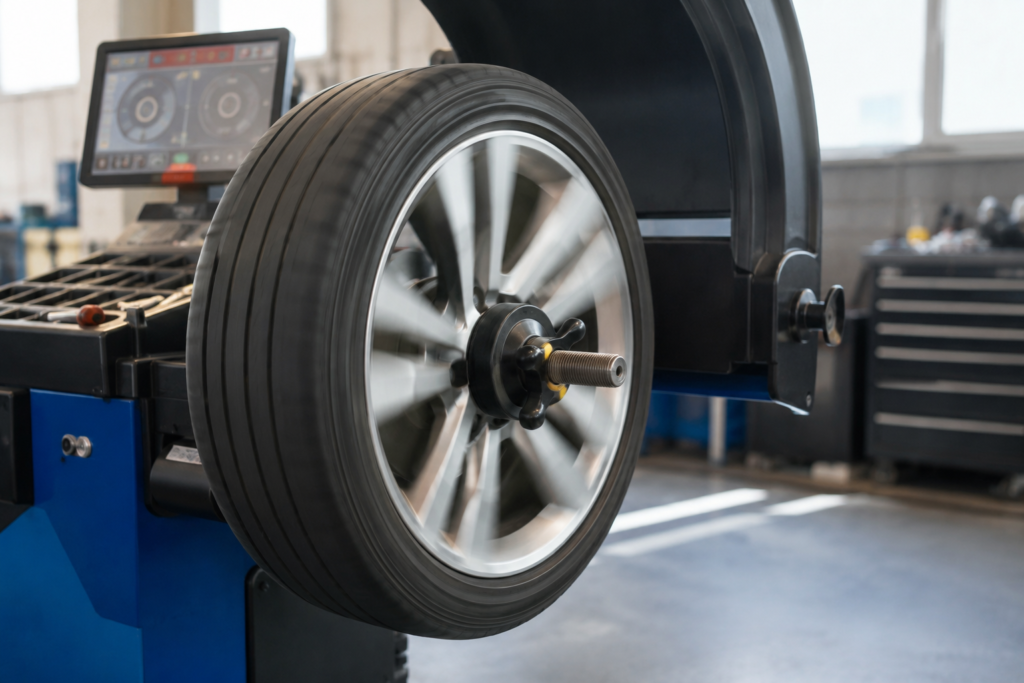
As a wheel rotates, even a slight imbalance in weight distribution creates centrifugal force. An extra 10–15 grams on one side of the wheel becomes a significant load at speeds above 100 km/h, continuously transmitting vibration to the suspension, steering system, and vehicle body.
To compensate for this effect, wheel balancing weights are installed. They neutralize the wheel’s heavy spot and ensure smooth, even rotation.
Technicians distinguish between two types of wheel imbalance:
- static imbalance, where the wheel tends to bounce up and down;
- dynamic imbalance, where the wheel moves from side to side while rotating.
The main symptoms of wheel imbalance usually become noticeable during highway driving. If the vibration is felt mostly through the steering wheel, the front wheels should be inspected first. If the vibration is mainly transmitted through the seat or vehicle body, the rear wheels should also be checked.
Why the Wheel Rim May Be Fine While the Vibration Remains
Not every vibration means the wheel rim needs to be repaired or straightened.
After driving off road, during winter, or in rainy conditions, mud, wet snow, or sand often accumulates on the inside of the wheel rim. Even a small amount of debris shifts the wheel’s center of mass and creates imbalance.
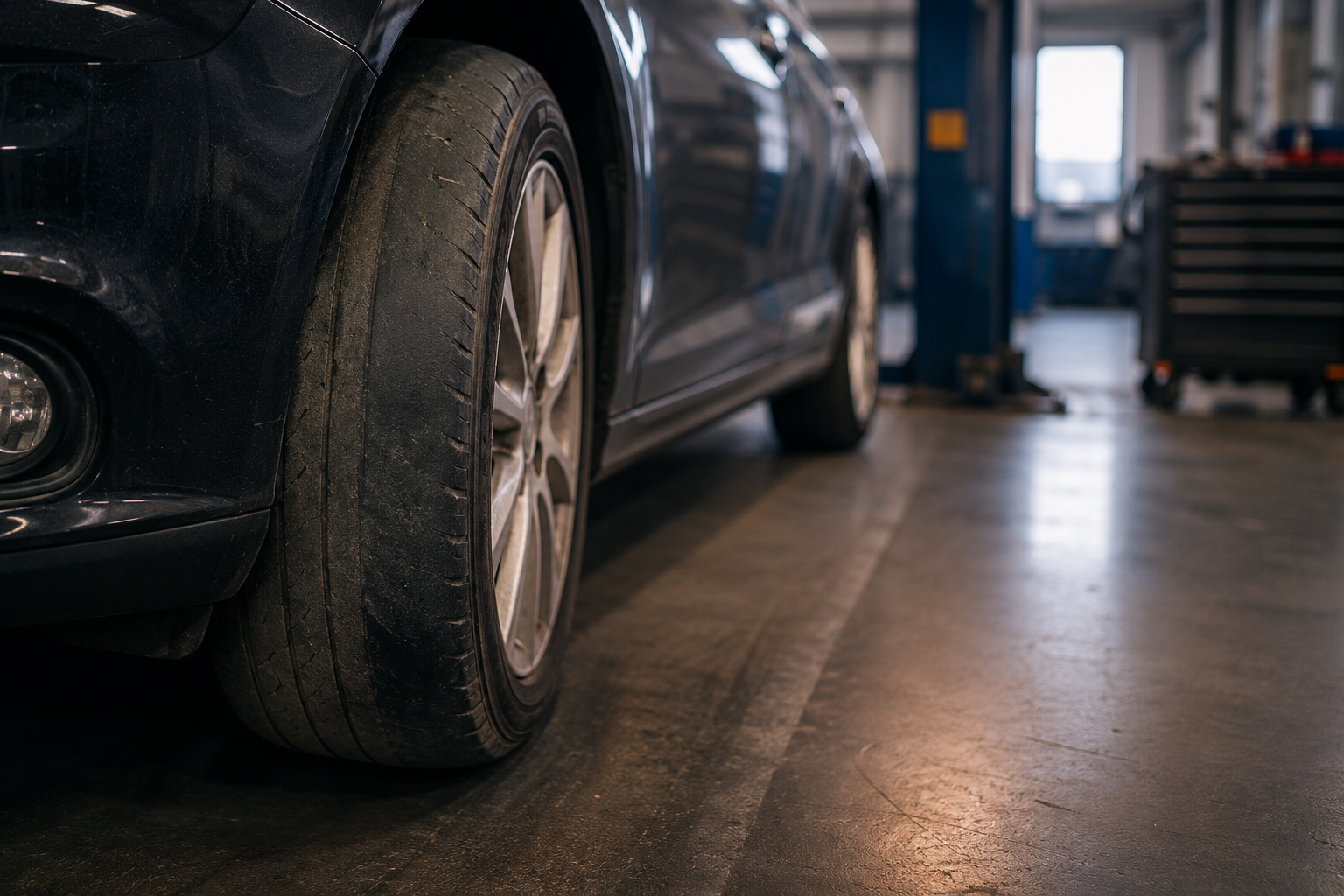
Another possible cause is radial tire runout resulting from damaged tire cords or an internal sidewall bulge. From the outside, the tire may appear perfectly normal while producing uneven forces as it rotates. This is why identifying a defective tire without a professional wheel balancing machine can be difficult.
Proper wheel centering on the hub is equally important. If the hub centric ring is missing, incorrectly sized, or installed improperly, the wheel becomes slightly offset from its rotational axis. In this case, even a properly balanced wheel can still produce noticeable vibration.
When Wheel Balancing Will Not Solve the Problem
If installing new balancing weights does not eliminate the vibration, the following components should be inspected:
- damaged tire cords;
- a tire sidewall bulge;
- a bent wheel hub;
- wheel bearing play;
- deformed suspension components.
If the balancing machine continues to show excessive imbalance after several attempts, it may indicate a hidden defect in the tire or the wheel itself. In such cases, balancing alone cannot solve the problem.
It is also important to check whether a balancing weight has fallen off. This often happens after hitting a pothole, striking a curb, or improper tire removal. As a result, vibration may appear suddenly even though the vehicle was previously driving smoothly.
If the steering wheel vibrates at high speed, do not immediately blame the wheel rim. A complete inspection will identify the actual cause of the problem and help avoid unnecessary repair costs.
How Often Should Wheels Be Balanced?
Wheel balancing should not be performed only during seasonal tire changes. It is also recommended after a severe impact with a pothole, after losing a balancing weight, or every 8,000–10,000 kilometers (5,000–6,200 miles).
Regular wheel balancing not only eliminates vibration but also reduces stress on wheel bearings, shock absorbers, steering components, and other suspension parts.
Why Professional Tire Service Matters
The cost of wheel balancing in Kyiv depends on the wheel diameter, wheel type, and vehicle design. However, achieving accurate results depends not only on a modern balancing machine but also on proper wheel installation, precise equipment calibration, and the technician’s experience.
During professional tire service in the Sviatoshyn district, experienced technicians inspect not only wheel balance but also the condition of the tires, wheel rims, hub centric rings, and wheel hub mounting surfaces. This comprehensive approach helps eliminate the true source of vibration while protecting wheel bearings, shock absorbers, and other suspension components from premature wear.
Top popular news
- Vehicle Maintenance Schedule by Mileage: What Really Needs to Be Replaced at 30,000, 60,000, and 90,000 km
- Importing a Car from the USA to Ukraine: Required Documents and Customs Clearance Costs
- Switching from LPG to Gasoline While Driving: Why the Switching Valve Sometimes Fails
- Car Air Conditioner Disinfection: Why It Is Necessary and How Often It Should Be Done
- CV Boot: Why Replacing It Costs Much Less Than Repairing the Drive Shaft
- Wheel Bearing Noise: How to Identify Which Wheel Is Faulty
- Car Soundproofing: Where to Start for the Best Results
- Factory Paint Thickness of a Car: How to Read Paint Thickness Gauge Measurements

Subscribe to our newsletter!
To stay updated with the latest news


Book a service