Mon-Fri | 08:00 - 20:00


Find

Contact us

Kyiv
46 Kyrylivska St. (Podil)
 Мережа СТО в місті

Kyiv
46 Kyrylivska St. (Podil)
 Мережа СТО в місті

 Години роботи
 Mon-Fri
08:00 - 20:00
Engine air and cabin filter replacement: why urban conditions change service intervals
Vehicle filters are among the main service consumables that affect stable engine operation and comfort while driving. Manufacturers specify recommended replacement intervals based on average operating conditions: clean roads, moderate dust levels, and regular trips without excessive load on the vehicle’s systems.
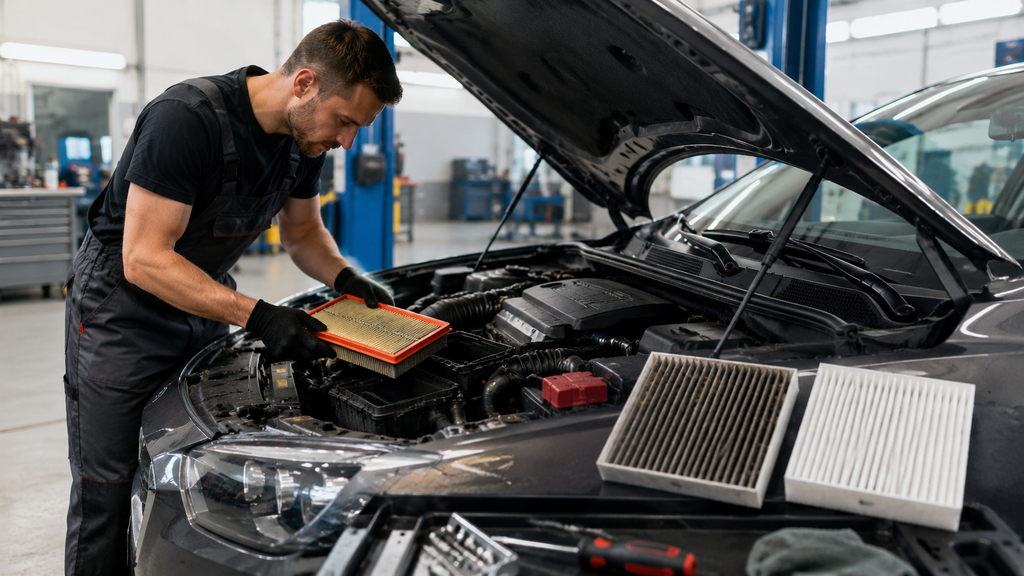
Urban driving differs from these conditions. Constant traffic jams, dust, exhaust gases, construction debris, and short trips place additional load on the filter elements.
As a result, the engine air and cabin filter replacement interval does not always match the factory recommendation. Actual service life depends on the environment in which the vehicle is used.
Manufacturer service schedules are based on standard conditions
The service interval specified by the manufacturer is a guideline for a typical operating scenario. It does not always account for daily driving in dense city traffic or operating the vehicle on dusty roads.
The engine air filter traps dirt particles before air enters the intake system. The cabin filter cleans the airflow entering the passenger compartment through the ventilation and air-conditioning system.
The rate of contamination is affected by:
- road surface quality;
- how often the vehicle is driven in the city;
- the season of operation;
- air quality in the area where the vehicle is used;
- how frequently the climate-control system operates.
When deciding how often to replace filters in city driving, it is necessary to consider not only mileage but also actual driving conditions.
A dirty engine air filter changes how the engine operates
For normal fuel combustion, the engine needs a sufficient volume of air. As the filter element gradually fills with dust, resistance to airflow increases.
As a result, the engine management system has to adapt intake operation, which can affect performance and fuel consumption.
Possible signs of a clogged engine air filter include:
- slower acceleration;
- increased fuel consumption;
- unstable engine operation;
- poorer response to accelerator input.
Restricted airflow also affects other intake-system components. For example, the throttle body becomes dirty more quickly and engine operation may become less stable.
Replacing a filter is a much simpler procedure than repairing the consequences of prolonged operation with restricted airflow.
The cabin filter determines air quality inside the vehicle
The cabin filter protects the passenger compartment from dust, fine particles, and contaminants entering from outside.
Once its service life is exhausted, the ventilation system loses efficiency. Air passes through the contaminated material more slowly, which changes the performance of the heating and air-conditioning systems.
The following signs may indicate a problem:
- weak airflow from the vents;
- an unpleasant smell when ventilation is switched on;
- windows fogging up again quickly;
- dust accumulating inside the cabin.
The effects of a dirty cabin filter are especially noticeable in damp weather, when restricted airflow causes the windows to clear more slowly.
In addition to discomfort, a contaminated element is less effective at trapping pollen, fine particles, and allergens in the cabin.
Carbon cabin filter or standard filter: which one to choose
A standard cabin filter performs the basic task of removing dust and mechanical contaminants from the air. A carbon filter also contains a layer of activated carbon that helps reduce unpleasant odours and some harmful impurities entering the cabin.
The choice between a carbon cabin filter or a standard filter depends on how the vehicle is used.
For city driving, where exhaust gases and external odours are common, a carbon version is often the more practical choice. However, even a high-quality filter has a limited service life and needs timely replacement.
How to check filter condition without special equipment
The approximate condition of the elements can be assessed during a simple visual inspection.
The engine air filter should be checked for:
- significant darkening of the material;
- dust accumulated between the pleats;
- damage to the housing;
- damage to the seal.
The cabin filter can also be inspected after removal. A large amount of dust, foreign particles, or an unpleasant odour indicates that replacement is needed.
At the same time, appearance does not always reveal the true condition of the filter. The material gradually loses effectiveness even without obvious contamination.
Should replacement intervals be shortened in a large city?
A vehicle used mainly outside the city operates with less load on its air-cleaning systems. Dense urban traffic creates a completely different operating environment.
Regular inspection and timely filter replacement help maintain normal engine operation, stable fuel consumption, and a comfortable cabin environment.
Service cost depends on the vehicle model, the type of elements installed, and how difficult they are to access. The final cost of filter replacement is therefore determined after assessing the vehicle model, filter type, and complexity of the work.
A shorter replacement interval in a large city is not an unnecessary expense; it is a way to keep vehicle systems in proper condition and avoid problems caused by prolonged operation with dirty filters.
Top popular news
- Preparing a car for a long trip: checklist before departure
- Oil leaking from the valve cover: causes of seepage and finding the source of the problem
- Automatic climate control does not maintain the set temperature: where to look for the cause
- Brake pipes and hoses: different designs with different risks
- Suspension spring sagging: gradual loss of performance without an obvious failure
- PCV crankcase ventilation valve: why a fault leads to oil leaks
- Headlights fogging from the inside: normal condensation or a sign of housing damage
- Steering rack: hydraulic leak or electric power-steering fault – how the problem is diagnosed

Subscribe to our newsletter!
To stay updated with the latest news


Book a service