Mon-Fri | 08:00 - 20:00


Find

Contact us

Kyiv
46 Kyrylivska St. (Podil)
 Мережа СТО в місті

Kyiv
46 Kyrylivska St. (Podil)
 Мережа СТО в місті

 Години роботи
 Mon-Fri
08:00 - 20:00
Clutch slipping in a manual transmission: how to tell when the disc or pressure plate needs replacement
A manual transmission allows the driver to control gear changes directly, but proper transmission operation is impossible without a healthy clutch. This assembly transfers power from the engine to the gearbox and ensures smooth pull-away.
The clutch consists of several main components: the clutch disc, pressure plate, release bearing, and operating mechanism. When the pedal is pressed, force is transmitted through the actuation mechanism to the release bearing, which acts on the pressure plate and temporarily disconnects the engine from the gearbox. When the pedal is released, the disc is pressed against the flywheel again and torque is transferred to the transmission.
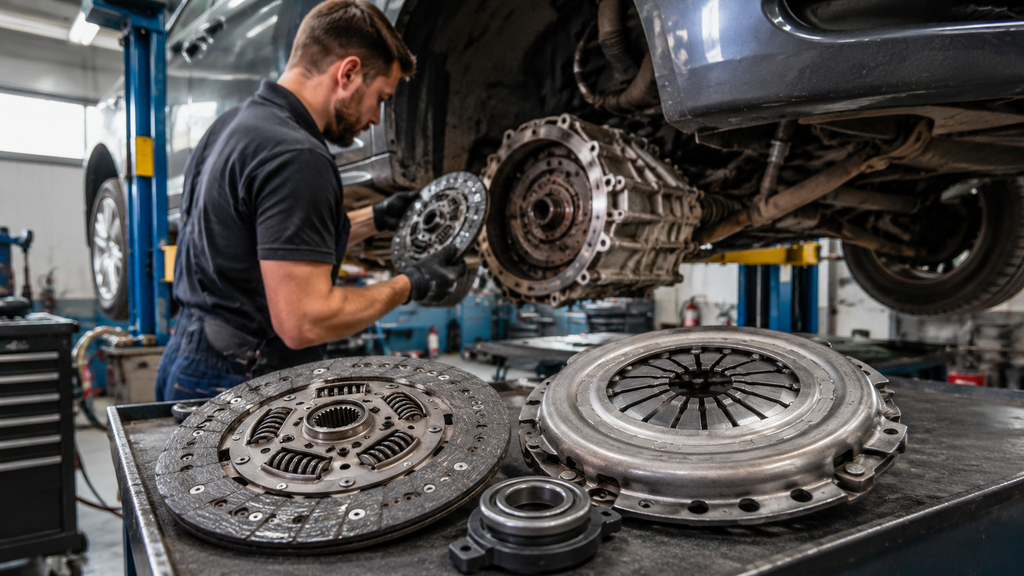
Over time, the friction linings on the clutch disc wear down and the clamping mechanism loses its original effectiveness. As a result, engine power is no longer transmitted fully to the wheels. This is how clutch slip develops, and at first it may go unnoticed in normal urban driving.
How the clutch works and why traction is lost
The clutch’s main task is to provide a reliable connection between the engine and gearbox without excessive slip. When the surfaces of the disc and flywheel are in firm contact, the vehicle accelerates evenly.
As the working surface wears, the disc begins to slip between the mating surfaces. The engine continues to run, but some energy is lost through excessive friction.
The condition of the assembly is affected by:
- the thickness of the clutch disc linings;
- the condition of the flywheel;
- the condition of the pressure plate;
- release bearing operation;
- correct adjustment of the clutch cable or hydraulic clutch system.
It is important to understand that the problem is not always caused by a single component. For example, a worn disc may operate together with a damaged pressure plate, so replacing only one part does not always produce the expected result.
How the car shows that the clutch is losing effectiveness
The main warning sign is usually noticed during acceleration. The accelerator is pressed and the engine speed rises, but the vehicle does not accelerate in proportion to the load.
This is the main sign that the clutch is slipping. It most often appears:
- during overtaking;
- on uphill sections;
- during hard acceleration in a high gear;
- when carrying a heavy load.
For example, the vehicle is travelling in fourth or fifth gear. The driver presses the accelerator, the tachometer quickly shows an increase in engine speed, but road speed rises with a delay. This behaviour often indicates that the disc can no longer transmit the full torque.
However, slipping is not the only problem. Vehicle owners often notice other changes in transmission operation as well.
Additional signs of clutch disc and pressure plate faults
The way a vehicle behaves when moving off and changing gears says a lot about the condition of the clutch. If the assembly is not working correctly, the driver may feel changes that were not present before.
Possible wear may be indicated by:
- a jerk when moving off;
- vibration as the pedal is released;
- a change in the normal pedal travel;
- difficulty engaging gears;
- unusual noises from the mechanism.
Particular attention should be paid to noise when the pedal is pressed. Release bearing knocking may indicate wear of this component, since the bearing is continuously loaded while the engine and gearbox are being disengaged.
Problems may also involve the clamping mechanism. Signs of clutch pressure plate wear include uneven torque transfer, vibration, and unstable behaviour when moving off. In some cases, the cause may not be the pressure plate itself but flywheel deformation or a fault in the clutch actuation system.
What shortens clutch service life
The service life of the mechanism depends not only on vehicle design. Driving style and operating conditions also have a major influence.
The greatest load occurs during prolonged clutch slip. For example, holding the vehicle on an incline with the clutch pedal or driving with the pedal partially depressed creates unnecessary friction.
Situations that accelerate wear include:
- frequent hard starts;
- prolonged slipping in city traffic;
- carrying loads above the permitted limit;
- incorrect use of the clutch pedal while driving;
- operating the vehicle with a faulty clutch actuation system.
Clutch service life in a manual transmission depends on operating conditions, driving style, and loads, so there is no universal lifespan for every vehicle. One clutch set may last much longer than another depending on operating conditions, engine output, and the owner’s driving habits.
When repairs should not be delayed
It may still be possible to drive with the first signs of clutch slip, but the problem gradually becomes worse. A worn disc generates more heat, which also affects neighbouring components.
Prolonged operation with a faulty clutch can lead to:
- flywheel overheating;
- pressure plate damage;
- complete wear of the friction linings;
- loss of the ability to transmit power properly;
- higher repair costs.
The cost of replacing the clutch disc depends not only on the price of the part but also on the condition of the pressure plate, release bearing, and flywheel. If wear of the pressure plate, release bearing, or flywheel is found during disassembly, the scope of work increases.
A timely inspection helps prevent minor wear from turning into a major transmission repair. Changes in pedal behaviour, a burning smell, or a delay between rising engine speed and actual acceleration are warning signs that should not be ignored.
Top popular news
- Preparing a car for a long trip: checklist before departure
- Oil leaking from the valve cover: causes of seepage and finding the source of the problem
- Automatic climate control does not maintain the set temperature: where to look for the cause
- Brake pipes and hoses: different designs with different risks
- Suspension spring sagging: gradual loss of performance without an obvious failure
- PCV crankcase ventilation valve: why a fault leads to oil leaks
- Headlights fogging from the inside: normal condensation or a sign of housing damage
- Steering rack: hydraulic leak or electric power-steering fault – how the problem is diagnosed

Subscribe to our newsletter!
To stay updated with the latest news


Book a service